
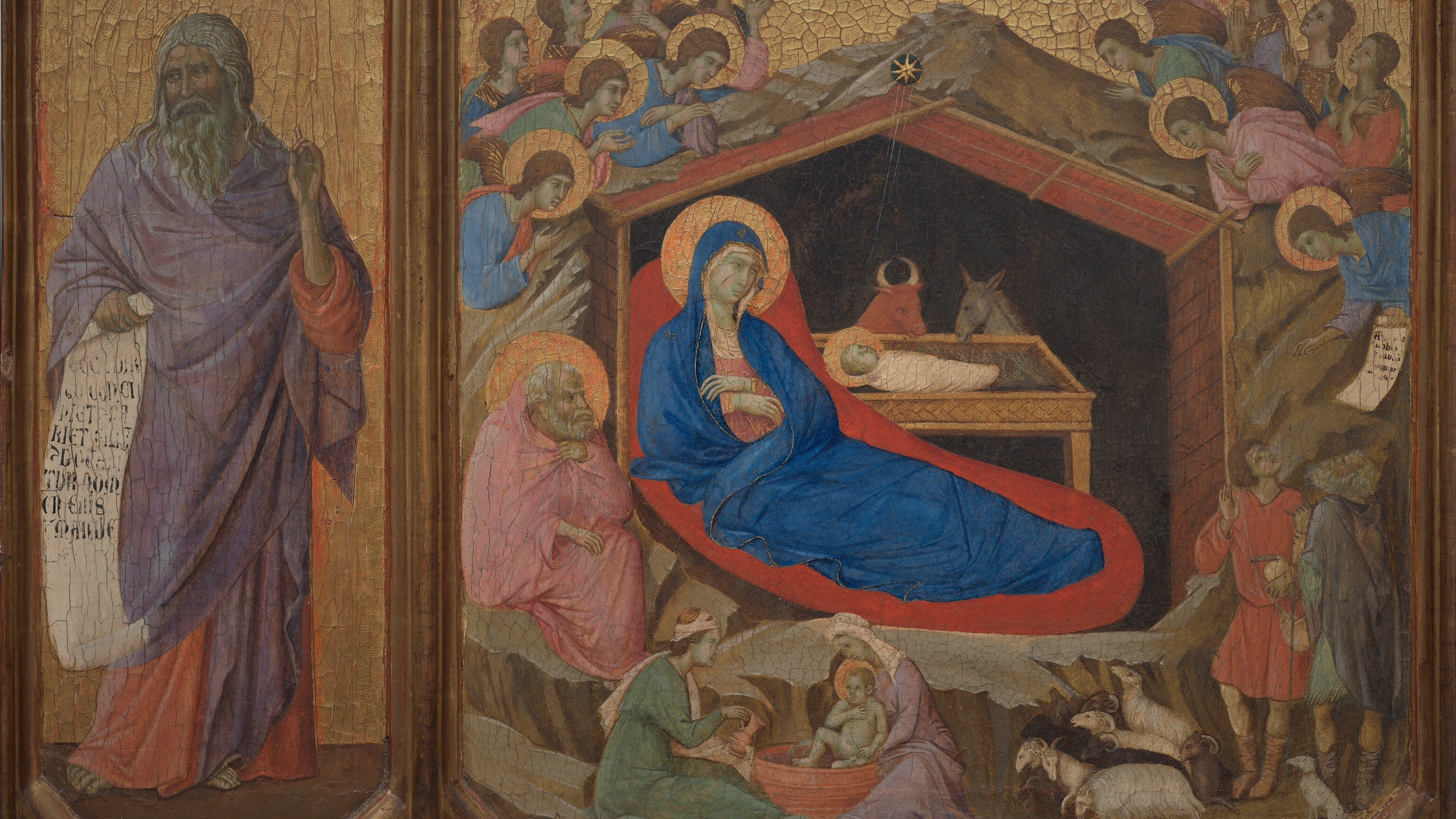
Hope in Exile
CALL TO WORSHIP | Isaiah 35:1-10
The wilderness and the dry land shall be glad; the desert shall rejoice and blossom like the crocus; it shall blossom abundantly and rejoice with joy and singing. The glory of Lebanon shall be given to it, the majesty of Carmel and Sharon. They shall see the glory of the Lord, the majesty of our God. Strengthen the weak hands, and make firm the feeble knees. Say to those who have an anxious heart, “Be strong; fear not! Behold, your God will come with vengeance, with the recompense of God. He will come and save you.” Then the eyes of the blind shall be opened, and the ears of the deaf unstopped; then shall the lame man leap like a deer, and the tongue of the mute sing for joy. For waters break forth in the wilderness, and streams in the desert; the burning sand shall become a pool, and the thirsty ground springs of water; in the haunt of jackals, where they lie down, the grass shall become reeds and rushes. And a highway shall be there, and it shall be called the Way of Holiness; the unclean shall not pass over it. It shall belong to those who walk on the way; even if they are fools, they shall not go astray. No lion shall be there, nor shall any ravenous beast come up on it; they shall not be found there, but the redeemed shall walk there. And the ransomed of the Lord shall return and come to Zion with singing; everlasting joy shall be upon their heads; they shall obtain gladness and joy, and sorrow and sighing shall flee away.
Song #1 – Just Because You Wanted Us by Johnathon van Deusen
Song #2 – Have You Found the Lord? by Porters Gate
Dismiss Kids
INTRO| Shaped In Our Waiting
Last week we began preparing ourselves for the season of Advent, a season that ironically means arrival, yet is a season of waiting, awaiting with expectation for the arrival of that for which all of history and humanity has hoped.
Waiting is not easy for us. We are enculturated to avoid the cue, to buy now rather than delay, and to avoid the void via distraction or production. Instinctively, it seems, we recognize the real pains of waiting. Waiting is difficult, forcing us to consider what has been, deal with that which is, even as we anticipate a future yet unknown. Such consideration can bring up things we’d rather avoid, and so we do.
Still, waiting is not always painful, at least not in the crushing sense. There is another kind of pain, the pain of exercise, of being strengthened through uneasy effort. Most people consider this a “good pain,” a pain with a purpose. In truth, we are shaped in our waiting, strengthened not only to endure the present but also to press on toward and enter the future.
If we want to be physically healthy, we know we need exercise, whether through weight training and workouts or simply through active labor. Strength of body is built up and maintained through such “good pain,” and so is strength of soul and spirit. That is why, as we prepare for a season of waiting, we are doing some warm-up exercises.
As I mentioned in this week’s Pastoral Note, we are not conditioned for the season of Advent. If anything, societally, we are conditioned against it! So we need to build up our stamina for the not-easy-but-good work of waiting ahead. Waiting, looking forward expectantly, is the invitation of Advent. And so, in our lead-up to Advent, we want to build our expectation, remember what it is we hope for, and how that hope is fulfilled.
To do this, we will be looking at the words of the prophet Isaiah. More than any other prophet, Isaiah most explicitly builds the expectation of the Christ, of Jesus. This is why, in nearly every tradition’s book of order, Isaiah is the most often quoted “Old Testament” writer during the Advent season.
But there is a slight irony to this fact. Isaiah is not writing about the Messiah at the peak of Israel’s reign, the height of God’s people’s faithfulness, but rather at the pit of their own making. Having aligned with foreign powers, mingled with foreign gods, and abandoned the telos of the law, “to love the Lord your God with all your heart, and soul, and strength, and to love your neighbor as yourself,” the so-called “children of God,” “bride of Yahweh,” were rebellious, adulterous, self-absorbed, and doomed by their own lust to be like everyone else. And yet, amid the worst, the ultimate depravity that would lead to the ultimate destruction, Isaiah speaks for God. God, through Isaiah, calls out his people, yes, but also instills in them a certain hope, building an expectation that their end is not the end, but the beginning of the end of all that has led them to this point.
So, let us continue building expectation for the advent of our hope. Will you pray with me as we enter this story that tells our story today?
PRE-SERMON READING | Isaiah 39
At that time Merodach-baladan the son of Baladan, king of Babylon, sent envoys with letters and a present to Hezekiah, for he heard that he had been sick and had recovered. And Hezekiah welcomed them gladly. And he showed them his treasure house, the silver, the gold, the spices, the precious oil, his whole armory, all that was found in his storehouses. There was nothing in his house or in all his realm that Hezekiah did not show them. Then Isaiah the prophet came to King Hezekiah, and said to him, “What did these men say? And from where did they come to you?” Hezekiah said, “They have come to me from a far country, from Babylon.” He said, “What have they seen in your house?” Hezekiah answered, “They have seen all that is in my house. There is nothing in my storehouses that I did not show them.” Then Isaiah said to Hezekiah, “Hear the word of the Lord of hosts: Behold, the days are coming, when all that is in your house, and that which your fathers have stored up till this day, shall be carried to Babylon. Nothing shall be left, says the Lord. And some of your own sons, who will come from you, whom you will father, shall be taken away, and they shall be eunuchs in the palace of the king of Babylon.” Then Hezekiah said to Isaiah, “The word of the Lord that you have spoken is good.” For he thought, “There will be peace and security in my days.”
SERMON | Hope in Exile
We saw last week that the rulers of Israel, Ahaz in chapter 1 and now Hezekiah in chapter 39, routinely misinterpret or misunderstand what the Lord is doing in their midst. Most often, from a mixed soul, hearts and minds devoted to what they have and what they want, while trying to maintain a rather shallow (though not necessarily disingenuous) submission to the way of the Lord, they cannot see what is really happening. Reality, that which is, is blurred.
While it is easy to make scapegoats of those whose responsibility is greater than ours and who should know better than we do, the truth is, as we discovered last week, that we are all, at times, wilfully blind to or ignorant of the work of God that ultimately redeems. A work that starts with judgment.
As we said last week, Judgment, the end of evil, including our own, is necessary. There cannot be true good while rebellion and arrogance, lust and violence remain. Yet judgment means an end, an end for us who are rightly judged. Still, there is hope in this judgment, that God judges not merely to end, to destroy that which is against the very good of existence, but also to save, to restore, to reestablish His very goodness in us, through us, and for us—to His glory, yes and amen, and for the good of all those judged.
This is our hope. That sin (and sinners) will be judged. An end to what brings death and the curse will be brought about, and yet, somehow, by sacrifice and grace, what is destroyed is not us or them, but only that no-thing which keeps us from the true thing, from life.
Rightly so, judgment scares us. But rightly so, we hope amid judgment, for we expect God to judge in a way that puts an end to what separates, divides, and leads to death, while at the same time restoring union and life. This is what we expect to arrive; this is the expectation of Advent proclaimed in Isaiah 9.
“The people who walked in darkness have seen a great light; those who dwelt in a land of deep darkness, on them has light shone. You have multiplied the nation; you have increased its joy; they rejoice before you as with joy at the harvest, as they are glad when they divide the spoil. For the yoke of his burden, and the staff for his shoulder, the rod of his oppressor, you have broken as on the day of Midian. For every boot of the trampling warrior in battle tumult and every garment rolled in blood will be burned as fuel for the fire. For to us a child is born, to us a son is given; and the government shall be upon his shoulder, and his name shall be called Wonderful Counselor, Mighty God, Everlasting Father, Prince of Peace. Of the increase of his government and of peace there will be no end, on the throne of David and over his kingdom, to establish it and to uphold it with justice and with righteousness from this time forth and forevermore. The zeal of the Lord of hosts will do this.” (Isaiah 9:2-7)
That indeed, as _______, who calledl us to worship read,
“Say to those who have an anxious heart, ‘Be strong; fear not! Behold, your God will come with vengeance, with the recompense of God. He will come and save you.’” (Isaiah 35:4)
Still, as the story goes, so go our stories. After judgment, after what we had falsely hoped in and falsely trusted to be the good, but was indeed some lesser version, and worse, some deepening form of nothingness, has been laid flat, leveled; and before…
“And a highway shall be there, and it shall be called the Way of Holiness; the unclean shall not pass over it. It shall belong to those who walk on the way; even if they are fools, they shall not go astray. No lion shall be there, nor shall any ravenous beast come up on it; they shall not be found there, but the redeemed shall walk there.” (Isaiah 35:8-9)
…there is the matter of exile to deal with.
“Then Isaiah said to Hezekiah, “Hear the word of the Lord of hosts: Behold, the days are coming, when all that is in your house, and that which your fathers have stored up till this day, shall be carried to Babylon. Nothing shall be left, says the Lord.” (Isaiah 39:6)
Perhaps we no longer fear judgment, seeing the necessity of all that divides and destroys—including within us—ended. As uneasy as it is to witness the just conclusion of evil within and without, as difficult as it is to experience the end of such nothing, “And nothing is very strong,” says Screwtape to Wormwood in C.S. Lewis’ classic—we expect something on the other side of judgment, we hope for the life after the end. Yet we, like Israel and like Jesus in the tomb, experience that universal feeling after things have been rocked, our world leveled, that we are in exile, not home. We are in limbo, the edge, the between what was and what will be. And like Dante’s limbo, it is a no-way; a haunting repetition without any certain path, no clear objective to guide us.
But unlike Dante’s limbo, and like the exile of God’s people and the days of darkness in the tomb of Jesus, exile has an end. Exile is the void, yes. To be in exile is to be forced to wait in the lostness of what was. It is both a consequence of what has been judged and a grace for what is to arrive. For, as we have already said, in our waiting we are strengthened. Our expectation for what is to come shapes us, just as it did the people taken to Babylon. In exile, their faith was sharpened and honed, and when they returned to the land of promise, they did so different, expectant, and ready for the arrival of hope.
But why? Why can we feel loss and lostness without being lost? Well, in the midst of exile, just as in the midst of judgment, we hear the Lord,
“Comfort, comfort my people, says God. Speak tenderly to Jerusalem, and cry to her that her hardship is ended, that her iniquity is pardoned, that she has received the LORD’s hand double for all her sins.” (Isaiah 40:1-2)
These renowned words of Advent, of arrival, are not first spoken at their realization but at the edge of judgment and exile, exile and return. A hope given in that will be long in coming. No quick return, but a shaping, refining, strengthening, waiting; with the certainty that what feels like limbo, an aimless suspension of soul and direction, is indeed nothing of the sort. Rather, what perpetuates our division must be judged and ended, and so we too must linger in the in-between, uprooted before we can be replanted, exiled, leaving behind what has been long enough to look forward to what will be. There is no return without a leaving. For indeed, that is what we hope for, a return not to what was but to something familiar yet different, renewed and whole:
A voice cries: “In the wilderness prepare the way of the Lord; make straight in the desert a highway for our God. Every valley shall be lifted up, and every mountain and hill be made low; the uneven ground shall become level, and the rough places a plain. And the glory of the Lord shall be revealed, and all flesh shall see it together, for the mouth of the Lord has spoken.” A voice says, “Cry!” And I said, “What shall I cry?” All flesh is grass, and all its beauty is like the flower of the field. The grass withers, the flower fades when the breath of the Lord blows on it; surely the people are grass. The grass withers, the flower fades, but the word of our God will stand forever. Go on up to a high mountain, O Zion, herald of good news; lift up your voice with strength, O Jerusalem, herald of good news; lift it up, fear not; say to the cities of Judah, “Behold your God!” Behold, the Lord God comes with might, and his arm rules for him; behold, his reward is with him, and his recompense before him. He will tend his flock like a shepherd; he will gather the lambs in his arms; he will carry them in his bosom, and gently lead those that are with young. (40:3-11)
So, will we wait? Let the waiting shape us? And find the hope in our exile?
REFLECTION
1) Do I expect God to upholster or uproot? Why should I not fear the latter?
2) Do I expect God to make something better or a Way to return to what is good?
3) How can waiting strengthen me for today’s (and tomorrow’s) labor?
CORPORATE COMMUNION & CONFESSION
INVITE PEOPLE TO THE FRONT TO RECEIVE THE ELEMENTS & RETURN TO THEIR SEATS
OFFICIANT READS
Beloved in the Lord Jesus Christ, the holy Supper we are about to celebrate is a feast of remembrance, communion, and hope.
We come in remembrance that our Lord Jesus Christ was sent of the Father into the world to assume our flesh and blood and to fulfill for us all obedience to the divine law, even to the bitter and shameful death of the cross. By his death, resurrection, and ascension, he established a new and eternal covenant of grace and reconciliation that we might be accepted of God and never be forsaken by him.
We come to have communion with this same Christ who has promised to be with us always, even to the end of the world. In the breaking of the bread he makes himself known to us as the true heavenly Bread that strengthens us unto life eternal. In the cup of blessing he comes to us as the Vine in whom we must abide if we are to bear fruit.
We come in hope, believing that this bread and this cup are a pledge and foretaste of the feast of love of which we shall partake when his kingdom has fully come, when with unveiled face we shall behold him, made like unto him in this glory.
Since by his death, resurrection, and ascension he has obtained for us the life-giving Spirit who unites us all in one body, so are we to receive this Supper in true familial love, mindful of the communion of saints everywhere and in all time who have believed and received the same. For as the holy Apostle says, “We being many are one body, for we are all partakers of that one bread.”
Unto this hope assist us, almighty God and Father of our Lord Jesus Christ, through your Holy Spirit. Amen.
MINISTER LEADS COMMUNION WITH THE WORDS OF THE INSTITUTION
The Lord Jesus, the same night he was betrayed, took bread; and when he had given thanks, he broke it and gave it to them, saying, “Take, eat; this is my body which is given for you: do this in remembrance of me.”
After the same manner also, he took the cup when they had supped, saying, “this cup is the new covenant in my blood: this do, as often as you drink it, in remembrance of me.”
INVITE ALL TO RECEIVE
HAVING RECEIVED, WE CONFESS (EMBOLEN (YELLOW) TOGETHER)
Bless the Lord, O my soul,
and all that is within me, bless his holy name.
Bless the Lord, O my soul,
and do not forget all his benefits
who forgives all your iniquity,
who heals all your diseases,
who redeems your life from the Pit,
who crowns you with steadfast love and mercy.
The Lord is merciful and gracious,
slow to anger and abounding in steadfast love.
He does not deal with us according to our sins,
nor repay us according to our iniquities.
For as the heavens are high above the earth,
so great is his steadfast love toward those who fear him;
as far as the east is from the west,
so far does he remove our transgressions from us.
As a father has compassion for his children,
so the Lord has compassion for those who fear him,
who did not spare his own Son,
but gave him up for us all,
and will also give us all things with him.
Therefore shall my mouth and heart show forth the praise of the Lord, from this time forth forevermore.
Amen
Song #3 – You are With Me by Leslie Jordan
Song #4 - Jesus, Anointed One by Chaz Holsomback
BENEDICTION | Isaiah 40:28-31
As we rest in the day made for us, we prepare to enter into the work for which we are made [LIGHT THE CANDLE], remembering…
The Lord is the everlasting God, the Creator of the ends of the earth. He does not faint or grow weary; his understanding is unsearchable. He gives power to the faint, and to him who has no might he increases strength. Even youths shall faint and be weary, and young men shall fall exhausted; but they who hope in the Lord shall renew their strength; they shall mount up with wings like eagles; they shall run and not be weary; they shall walk and not faint.
Hope in Judgement
CALL TO WORSHIP | Isaiah 9:2-7
The people who walked in darkness have seen a great light; those who dwelt in a land of deep darkness, on them has light shone. You have multiplied the nation; you have increased its joy; they rejoice before you as with joy at the harvest, as they are glad when they divide the spoil. For the yoke of his burden, and the staff for his shoulder, the rod of his oppressor, you have broken as on the day of Midian. For every boot of the trampling warrior in battle tumult and every garment rolled in blood will be burned as fuel for the fire. For to us a child is born, to us a son is given; and the government shall be upon his shoulder, and his name shall be called Wonderful Counselor, Mighty God, Everlasting Father, Prince of Peace. Of the increase of his government and of peace there will be no end, on the throne of David and over his kingdom, to establish it and to uphold it with justice and with righteousness from this time forth and forevermore. The zeal of the Lord of hosts will do this.
Song #1 – Anchor of Hope by Ellie Holcomb
Song #2 – Praise to the Lord by Traditional
Dismiss Kids
INTRO | Preparing for Advent
It is hard to believe that in just a few weeks, November will conclude and we will enter our (my!) favorite season, Advent!
Advent has become a special time for our faith family over the years. Not all of us grew up celebrating, much less understanding, the season of Advent. It was all just Christmas to us. Yet, as we have learned over the years from history and from one another, this season before the Christmas season plays an important role in the formation of our faith.
The word “advent” comes from the Latin word meaning “coming, a coming into place, or arrival.” Advent connotes a pulsating sense of expectation. It is the expectation of Christ’s (or the Messiah’s) immersion with his people and of the Redeemer’s final consummation. It is also the expectation of union with God and the restoration of all that is “very good.” All the hope of history and humanity, bottled into one word!
Over these days leading up to the beginning of Advent, our goal is to build our expectation. To enter into the story of humanity and discover, feel, rest in, and live from the hope of what was expected and still is. To do this, we will be looking at the words of the prophet Isaiah.
Isaiah writes at a time when all seemed hopeless. Indeed, all that God’s people had hoped to become as they entered the land of promise, freed from the forces of external oppression, would soon be lost. Their capital city, the seat of power and of God, would be destroyed, and the nation (already divided and combative) would be overtaken, its people dispersed and exiled. And yet, amid the judgment and through the exile and suffering, there remained a powerful force, an expectation of change, of renewal, of good, a hope being built so that when hope arrived (at hope’s advent) the people in the darkness would become the people in the light.
So, as Isaiah did, we do, building expectation for the advent of our hope. Will you pray with me as we enter into the story today?
PRE-SERMON READING | Isaiah 1:21-31
How the faithful city has become a whore, she who was full of justice! Righteousness lodged in her, but now murderers. Your silver has become dross, your best wine mixed with water. Your princes are rebels and companions of thieves. Everyone loves a bribe and runs after gifts. They do not bring justice to the fatherless, and the widow’s cause does not come to them. Therefore the Lord declares, the Lord of hosts, the Mighty One of Israel: “Ah, I will get relief from my enemies and avenge myself on my foes. I will turn my hand against you and will smelt away your dross as with lye and remove all your alloy. And I will restore your judges as at the first, and your counselors as at the beginning. Afterward you shall be called the city of righteousness, the faithful city.” Zion shall be redeemed by justice, and those in her who repent, by righteousness. But rebels and sinners shall be broken together, and those who forsake the Lord shall be consumed. For they shall be ashamed of the oaks that you desired; and you shall blush for the gardens that you have chosen. For you shall be like an oak whose leaf withers, and like a garden without water. And the strong shall become tinder, and his work a spark, and both of them shall burn together, with none to quench them.
SERMON | Hope in Judgment
More than any other prophet, Isaiah most explicitly builds the expectation of the Christ, of Jesus. This is why St. Irenaeus refers to Isaiah so often in his seminal text on the standard of our faith (OAP) and why, in nearly every tradition’s book of order, Isaiah is the most often quoted “Old Testament” writer in the Advent season.
But again, there is a slight irony to this. Isaiah is not writing of the Messiah at the peak of Israel’s reign, the height of God’s people’s faithfulness, but rather at the pit of their own making. Having aligned with foreign powers, mingled with foreign gods, and abandoned the telos of the law “to love the Lord your God with all your heart, and soul, and strength, and to love your neighbor as yourself,” the so-called “children of God,” “bride of Yahweh,” were rebellious, adulterous, and doomed by their own lust to be like everyone else. And yet, amid the worst, the ultimate depravity that would lead to the ultimate destruction, Isaiah speaks for God. God, through Isaiah, calls out his people and also instills in them a certain hope, building in them an expectation that their end is not the end but the beginning of the end of all that has led them to this point.
So, let’s look at some of these Advent season prophecies, words spoken during a season of arrival, but first spoken in a season of hope lost. And let us see if we cannot find, in the context of their first speaking, something important for life on the other side of their fulfillment.
Probably the most familiar words of Isaiah come in the opening chapters. The expectation of who we come to know as Jesus is spoken amid the condemnation of all that Jesus came to rescue us from. After the judgment of Jerusalem, which ____ read for us, we read:
“The word that Isaiah the son of Amoz saw concerning Judah and Jerusalem. It shall come to pass in the latter days that the mountain of the house of the LORD shall be established as the highest of the mountains, and shall be lifted up above the hills; and all the nations shall flow to it, and many peoples shall come and say, ‘Come, let us go up to the mountain of the LORD, to the house of the God of Jacob, that he may teach us his ways and that we may walk in his paths.’ For out of Zion shall go forth the teaching, and the word of the LORD from Jerusalem. He shall judge between the nations, and shall decide disputes for many peoples; and they shall beat their swords into plowshares, and their spears into pruning hooks; nation shall not lift up sword against nation, neither shall they learn war anymore. O house of Jacob, come, let us walk in the light of the LORD.” (Isaiah 2:1-5)
After the doubt and faithlessness of Ahaz, and before the impending doom of the doubters and deceivers is described, we read:
“Again the LORD spoke to Ahaz: ‘Ask a sign of the LORD your God; let it be deep as Sheol or as high as heaven.’ But Ahaz said, ‘I will not ask, and I will not put the LORD to the test.’ And Isaiah said, ‘Hear then, O house of David! It is too little for you to weary men, that you weary my God also? Therefore the Lord himself will give you a sign. Behold, the virgin shall conceive and bear a son, and shall call his name Immanuel [God is with us].” (Isaiah 7:10-14)
After the condemnation of the conspiracy theorist and the diviners who claim to see what they do not, and before the judgment of the arrogant and the oppressive, we read:
“The people who walked in darkness have seen a great light; those who dwelt in a land of deep darkness, on them has light shone. You have multiplied the nation; you have increased its joy; they rejoice before you as with joy at the harvest, as they are glad when they divide the spoil. For the yoke of his burden, and the staff for his shoulder, the rod of his oppressor, you have broken as on the day of Midian. For every boot of the trampling warrior in battle tumult and every garment rolled in blood will be burned as fuel for the fire. For to us a child is born, to us a son is given; and the government shall be upon his shoulder, and his name shall be called Wonderful Counselor, Mighty God, Everlasting Father, Prince of Peace. Of the increase of his government and of peace there will be no end, on the throne of David and over his kingdom, to establish it and to uphold it with justice and with righteousness from this time forth and forevermore. The zeal of the Lord of hosts will do this.” (Isaiah 9:2-7)
After the judgment of the means of judging and before the judgment that extends to all the nations, we read:
“There shall come forth a shoot from the stump of Jesse, and a branch from his roots shall bear fruit. And the Spirit of the LORD shall rest upon him, the Spirit of wisdom, and understanding, the Spirit of counsel and might, the Spirit of knowledge and the fear of the LORD. And his delight shall be in the fear of the LORD. He shall not judge by what his eyes see, or decide disputes by what his ears hear, bu with righteousness he shall judge the poor, and decide with equity for the meek of the earth; and he shall strike the earth with the rod of his mouth, and with the breath of his lips he shall kill the wicked. Righteousness shall be the belt of his waist, and faithfulness the belt of his loins. The wolf shall dwell with the lamb, and the leopard shall lie down with the young goat, and the calf and the lion and the fattened calf together; and a little child shall lead them. The cow and the bear shall graze; their young shall lie down together; and the lion shall eat straw like the ox. The nursing child shall play over the hole of the cobra, and the weaned child shall put his hand in the adder’s den. They shall not hurt or destroy in all my holy mountain; for the earth shall be full of the knowledge of the LORD as the waters cover the sea. In that day the root of Jesse, who shall stand as a signal for the peoples—of him shall the nations inquire, and his resting place shall be glorious.” (Isaiah 11:1-10)
Judgment, the end of evil, including our own, is necessary. There cannot be true good while rebellion and arrogance, lust and violence remain. Yet judgment means an end, an end for us who are rightly judged. Still, there is hope in this judgment, that God judges not merely to end, to destroy that which is against the very good of existence, but also to save, to restore, to reestablish His very goodness in us, through us, and for us—to His glory, yes and amen, and for the good of all those judged.
This is our hope. That sin (and sinners) will be judged. An end to what brings death and the curse will be brought about, and yet, somehow, in some way, by sacrifice and grace, what is destroyed is not us or them, but only that no-thing which keeps us from the true thing, from life.
Rightly so, judgment scares us. But rightly so, we hope amid judgment, for we expect God to judge in a way that puts an end to what separates, divides, and leads to death, and at the same time restores union and life. This is what we expect to arrive; this is the expectation of Advent.
REFLECTION |
Do I expect God to judge sin (including my own)? Why should I not fear that?
Do I expect God’s judgment to destroy? Why should I not?
How can a hope in restoration through judgment (re)shape my prayers and relationships this week?
CORPORATE COMMUNION & CONFESSION |
INVITE PEOPLE TO THE FRONT TO RECEIVE THE ELEMENTS & RETURN TO THEIR SEATS
OFFICIANT READS
Beloved in the Lord Jesus Christ, the holy Supper we are about to celebrate is a feast of remembrance, communion, and hope.
We come in remembrance that our Lord Jesus Christ was sent of the Father into the world to assume our flesh and blood and to fulfill for us all obedience to the divine law, even to the bitter and shameful death of the cross. By his death, resurrection, and ascension, he established a new and eternal covenant of grace and reconciliation that we might be accepted of God and never be forsaken by him.
We come to have communion with this same Christ who has promised to be with us always, even to the end of the world. In the breaking of the bread he makes himself known to us as the true heavenly Bread that strengthens us unto life eternal. In the cup of blessing he comes to us as the Vine in whom we must abide if we are to bear fruit.
We come in hope, believing that this bread and this cup are a pledge and foretaste of the feast of love of which we shall partake when his kingdom has fully come, when with unveiled face we shall behold him, made like unto him in this glory.
Since by his death, resurrection, and ascension he has obtained for us the life-giving Spirit who unites us all in one body, so are we to receive this Supper in true familial love, mindful of the communion of saints everywhere and in all time who have believed and received the same. For as the holy Apostle says, “We being many are one body, for we are all partakers of that one bread.”
Hereto assist us the almighty God and Father of our Lord Jesus Christ, through his Holy Spirit. Amen.
MINISTER LEADS COMMUNION WITH THE WORDS OF THE INSTITUTION
The Lord Jesus, the same night he was betrayed, took bread; and when he had given thanks, he broke it and gave it to them, saying, “Take, eat; this is my body which is given for you: do this in remembrance of me.”
After the same manner also, he took the cup when they had supped, saying, “this cup is the new covenant in my blood: this do, as often as you drink it, in remembrance of me.”
INVITE ALL TO RECEIVE
HAVING RECEIVED, WE CONFESS (EMBOLEN (YELLOW) TOGETHER)
Bless the Lord, O my soul,
and all that is within me, bless his holy name.
Bless the Lord, O my soul,
and do not forget all his benefits
who forgives all your iniquity,
who heals all your diseases,
who redeems your life from the Pit,
who crowns you with steadfast love and mercy.
The Lord is merciful and gracious,
slow to anger and abounding in steadfast love.
He does not deal with us according to our sins,
nor repay us according to our iniquities.
For as the heavens are high above the earth,
so great is his steadfast love toward those who fear him;
as far as the east is from the west,
so far does he remove our transgressions from us.
As a father has compassion for his children,
so the Lord has compassion for those who fear him,
who did not spare his own Son,
but gave him up for us all,
and will also give us all things with him.
Therefore shall my mouth and heart show forth the praise of the Lord, from this time forth forevermore.
Amen
Song #3 – Brightest of the Morning Stars by Traditional/Holsomback
Song #4 – I Will Sing by Sandra McCracken
BENEDICTION | Isaiah 40:28-31
As we rest in the day made for us, we prepare to enter into the work for which we are made [LIGHT THE CANDLE], remembering…
The Lord is the everlasting God, the Creator of the ends of the earth. He does not faint or grow weary; his understanding is unsearchable. He gives power to the faint, and to him who has no might he increases strength. Even youths shall faint and be weary, and young men shall fall exhausted; but they who hope in the Lord shall renew their strength; they shall mount up with wings like eagles; they shall run and not be weary; they shall walk and not faint.